

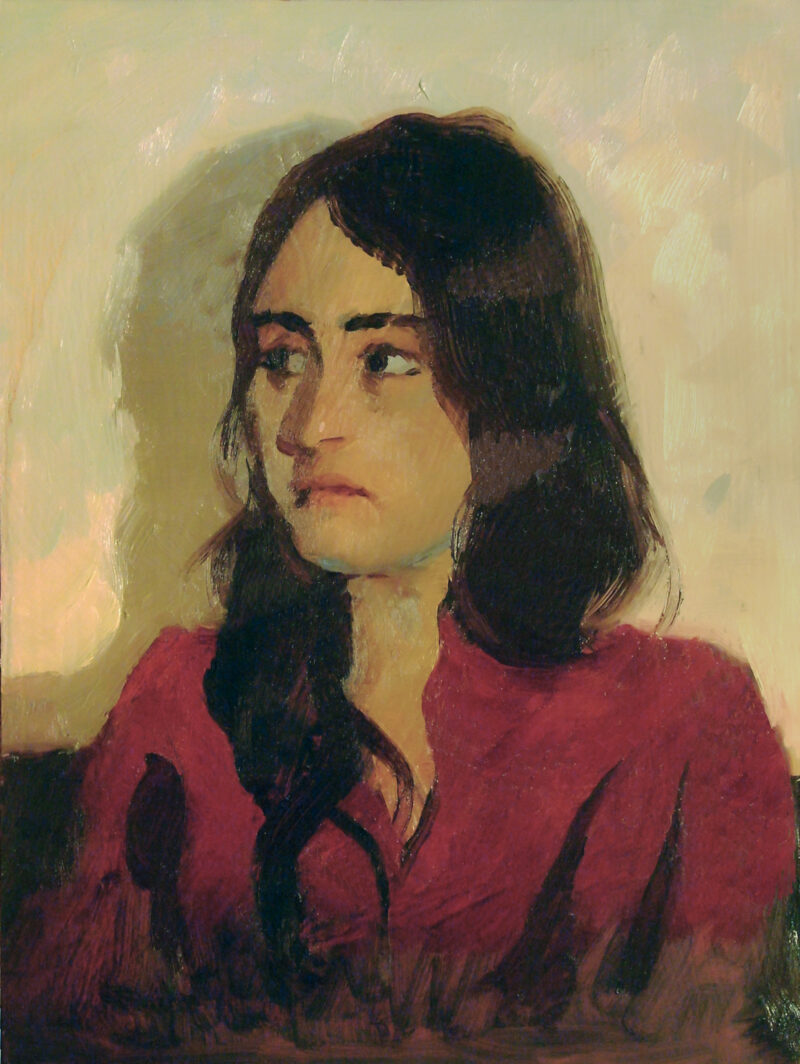
This lady sat too close to me on a half-full subway, preventing me from moving my drawing arm today.
This drawing is my revenge.
____________
Here’s some advice I gave someone via email about drawing today:
…
Draw Draw Draw!
Remember that no matter how you do things to do it your way. If you want to get good fast, you have to remember that even when you’re in workshop and you’re working on volume, gesture, or whatever, you’re doing it YOUR way.
You should always be having fun.
There isn’t one way you should be doing things and another way you shouldn’t.
Learning principles of drawing and painting is EASY by comparison to finding your own unique voice. It basically will take you between 3-5 years to become really good at those principles, but you’re going to be spending the rest of your life trying to find your own voice. And in the end, your own voice is all that matters. So whatever you do, you have to own it.
That said, don’t worry about “style.” You already have it, and in fact you can’t get away from it. The people who spend all that time in workshops but don’t seem to be improving are trying to cover up their own style. You have to let it come to the forefront if you want to really see improvement quickly.
The most important critique you will ever receive is your own. Ask yourself what you like about this piece. Then, ask yourself what you could do to make yourself like it more (be specific).
Crits from other people are helpful, but they aren’t as important as your own. Crits from others can help you to see things for yourself objectively, but ultimately they are just someone else saying what THEY would do. And that isn’t necessarily the best thing.
Another thing to remember: if you’re drawing for practice–i.e. in the workshops–keep in mind what you’re trying to get out of it. Are you trying to learn to draw figures out of your head? (try it and see; if you can’t do it, you should change how you approach figure drawing)
I heard this from Scott McCloud’s talk on TED recently, and I agree with it 100%:
1) Learn from everyone
2) Follow no one
3) Look for patterns
4) Work like hellI hope that’s helpful to you. I have a blog post a while back called “how to get better” that says the same thing a little differently. I hope you get some enjoyment or usefulness out of it: HOW TO GET BETTER
–frank



7 Comments
Add Yours →good post
Thank you for posting your advice. It’s greatly appreciated.
It’s a constant battle I have with myself when it comes to my work. I have a note on my iPod that reminds me to draw like I know how. This post reinforces that.
Great advice man!! Having fun is the key to drawing. Thanks man for the advice.
Frank, are you going to the Society Show this friday?
Awesome drawing!
Cheers,
Oliver
thanks for putting your thoughts down on “paper”. Even while working in big studios and having to keep “on model” these points ring true. In classical animation many people use the description “too stylized”, meaning the style is taking over for no good reason. I like your part about finding your own voice. That is really, really hard.
You know, my anatomy is reasonably good. I’ve got a pretty good foundation. When working from reference, I always seem to be able to interpret what’s going on under the skin pretty well, and am able to elaborate on what’s missing, but I’m very heavily reliant on reference to get naturalistic poses and I take TONS of digital photos before I do any figure work if I want those figures to resemble humans in a less than symbolic way. Often I don’t even use the specific poses that I shoot–I try to avoid rendering the photo–but I just can’t seem to draw figures with any great facility spontaneously out of my head. You seem to be really good at inventing figures out of your head, and I know there’s no “secret”, but I thought maybe you might have some advice.
I’ve had some really shitty figure classes over the years, and have always learned more from the model than the teacher–most of my figure teachers have had no real grasp of anatomy and most of what I know about anatomy has been from studying on my own, sitting down and copying images out of anatomy books. There was even an online anatomy course that I followed for a while. It’s just never magically come together for me as I always hoped it would, and has always been a struggle.
Any practical advice whatsoever would be appreciated.
Hey Jed,
I appreciate the compliment and the question.
The super short version of the answer to that question is that inventing figures out of your head isn’t about anatomy at all.
I’ll do a post about drawing figures out of your head in the near future.
f.
Thanks Frank! Much appreciated. Your answer is as intriguing as it is perplexing. I’ve always thought it was all about anatomy!
At San Jose State, when I was attending, it was assumed that you’d get your fundamentals elsewhere in the lower division courses, but the focus of the school in general (by no fault of the illustration department) was never particularly on fundamentals. I think that that’s since changed, but unfortunately I ended up with what I feel are some significant deficits.
I never learned how to render particularly well (as in paint realistically), my perspective aint too great (lately I’ve been making up for that one with Google sketch-up), and I’m no good at all at inventing figures out of my head, not for a lack of trying. My one notable skill–a facility with pen, brush and ink, is one I cultivated on my own.
But I never gave up or stopped learning, and I’m finally to a point where I can look at things I did 5 or 6 years ago without embarrassment. Everything before then I’d like to bury. This, to me, attests to the fact that it’s not everyone who reaches full maturity as an artist in their 20s. At 35 I think I’m just starting to get a little confidence. I’m sure everyone feels like their still learning, but it takes longer for some than others to build that confident foundation.