
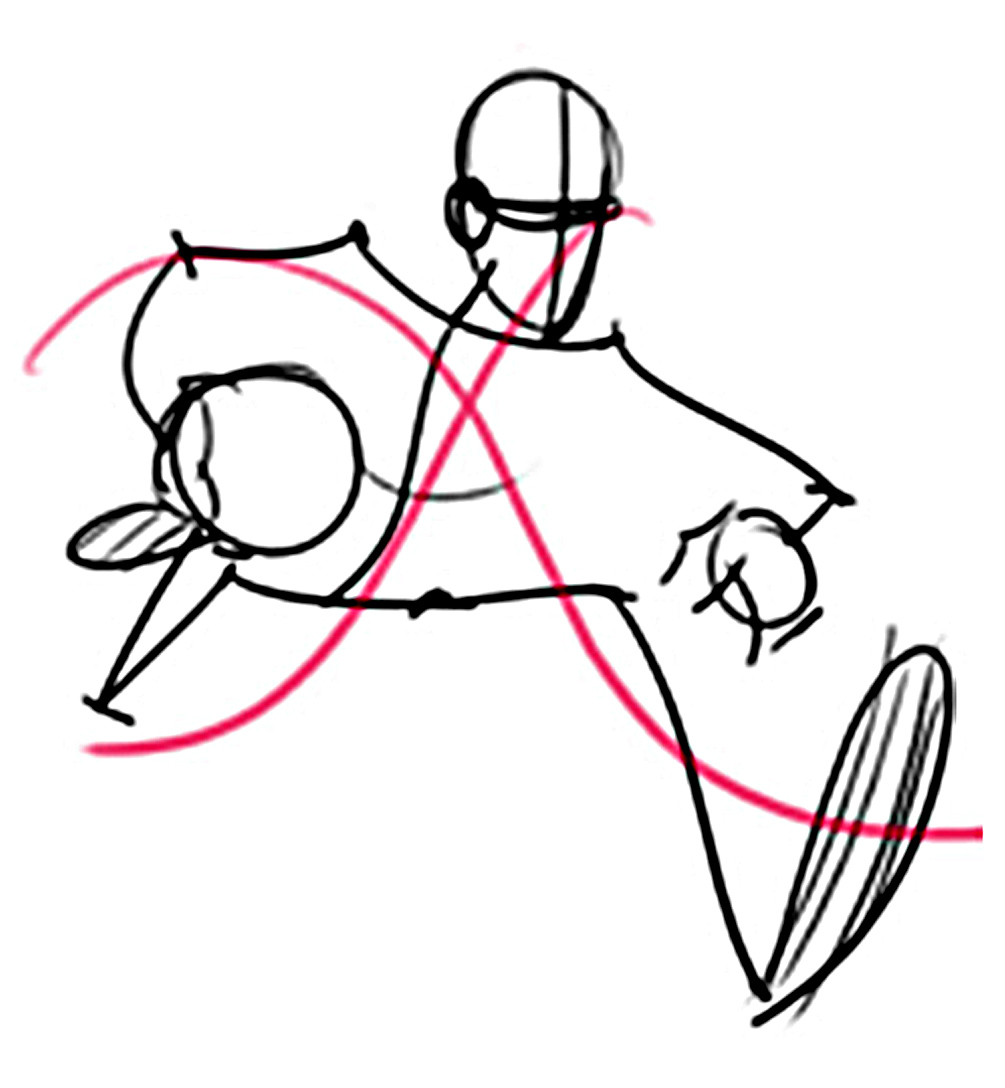
Over the next few months I’m going to be posting some articles about teaching yourself to draw from your imagination. These ideas expressed on the subject of drawing come from both my own observations and from lectures from several fantastic drawing teachers I have had the privilege of studying with, such as Kevin Chen, Dallas Good, Steve Huston and Bob Kato.
Keep in mind that this is general theory and not to be taken as hard, fast rules about what makes a drawing “good.” In fact, when it comes to making art, it’s the ways in which we diverge from the principles that gives artwork its originality, style, and charm.
Also keep in mind that nothing I or anyone else says are going to make you instantly better; that’s only going to come gradually and with a lot of hard work drawing people on your own and from life.
Gesture
There are two elements present in all kinds of art: IDEA and FORM.
The IDEA is what you want to express, and the FORM is the different elements that make up the piece.
Another way of saying that is the form is like the notes on a piano, and the idea is how you string them together. And as in music, the quality comes not from how well you hit the keys but how they all relate to one another to form a song.
The GESTURE is the IDEA of a figurative drawing.
This can also be described as the “story,” or the “pose.” When related to drawing, these terms can be used interchangeably, and in fact I prefer to use the word “story” instead of gesture when talking about drawing because it is often much clearer as to what the goal is.
GESTURE = IDEA = STORY
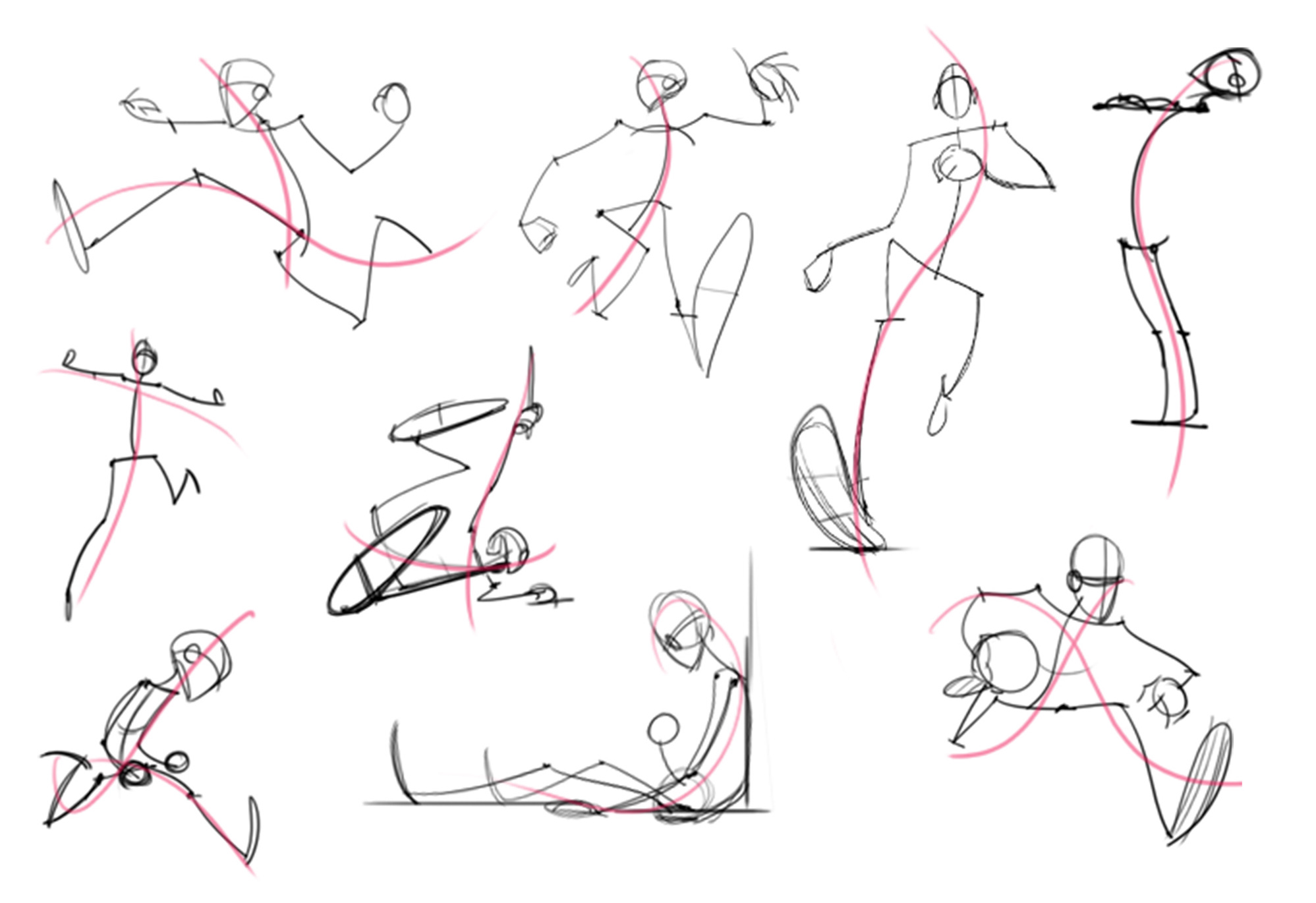
These “stick figures” aren’t necessarily how I will start to lay out a figure; rather, they’re designed to illustrate what the gesture should convey. Through trial and error, you’ll eventually find your own way of laying in a gesture on which you can add more detail later.
If gesture means the same thing as story, then it should be clear that a “gesture drawing” isn’t just a bunch of scribbles done in 30 or 60 seconds from the model, as was my understanding of it from the earliest days of figure drawing.
A gesture is any line or set of lines that gets the story across.
The gesture the most important element in drawing figures by far, because if you fail to tell a convincing story, no amount of style, anatomy, or rendering will ever be able to fix it.
A good draftsman can tell a complex story with stick figures because of his or her grasp of this concept.
I’ve chosen to use stick figures here to illustrate the point that people will forgive 95% of all your other artistic shortcomings if you can tell the story well.
This is where a lot of drawings fall apart, either in the beginning or in the later stages as you get farther away from the core message of what you’re trying to say.
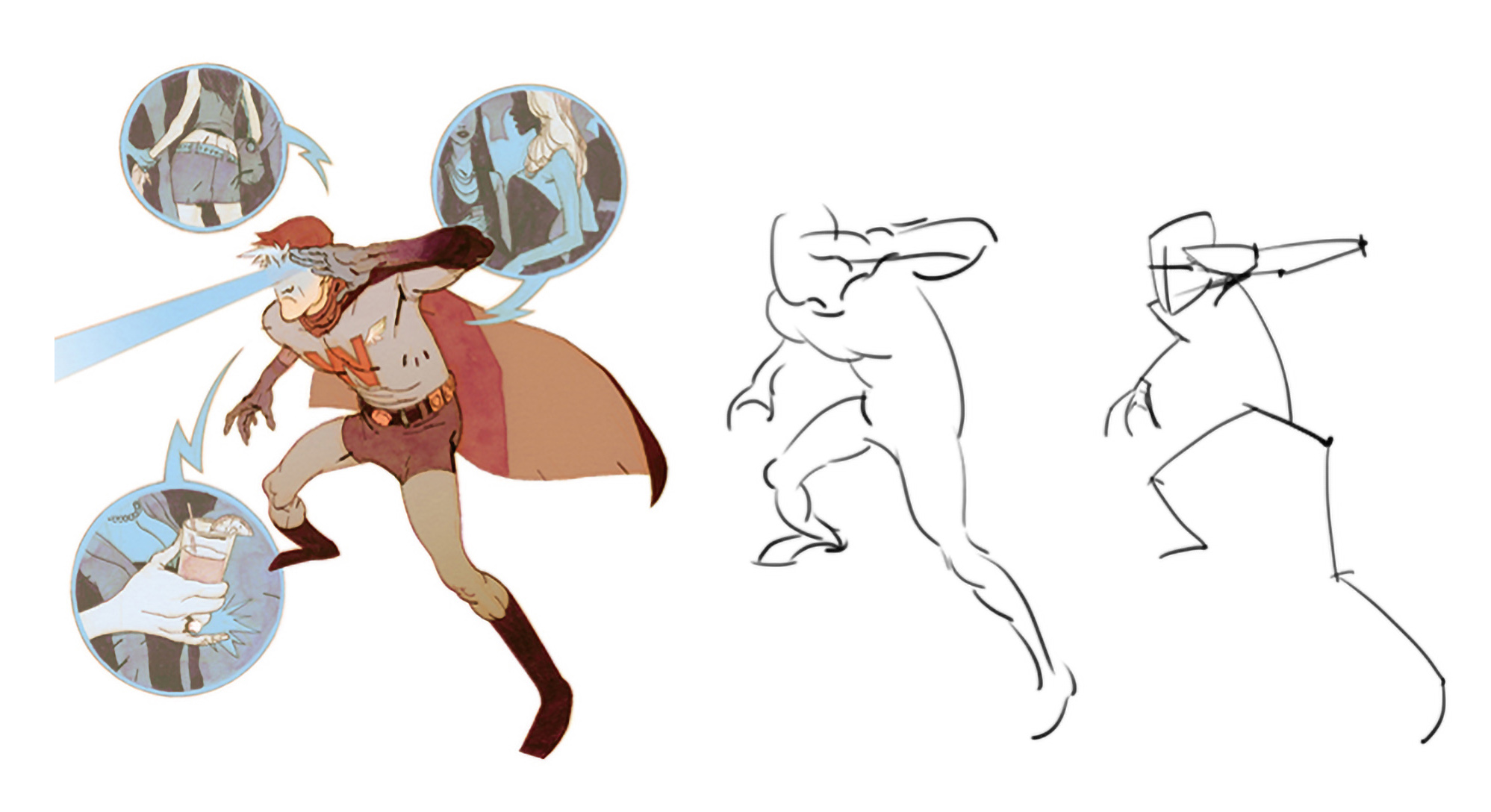
When in the early stages of learning to draw, it’s often a good idea to start your gesture off with a single, usually swooping “action line” essentially serves as the “theme” of the figure. This concept is described in greater detail and with many fantastic examples in John Buscema’s “How To Draw Comics the Marvel Way.”
Also, I should note that the example drawings posted here don’t necessarily represent my personal process of drawing; for that, you can look through older blog posts and get an idea of how I come up with my poses; it’s a lot more organic and scribbly most times than it looks here. You’re going to want to develop your own process, which I will talk about in another post.
Every line you put down should serve to strengthen the basic idea of the pose. If you’re drawing a person who is tired or depressed, not only should your initial first few lines get that point across, but subsequent design decisions you make should reinforce that message. The reason being is that every time you put down a mark that gets away from the core idea, the less effectively it communicates its intended message.
In my opinion, the people who are the best at drawing from their imagination are usually animators. It’s an animator’s job to tell stories through pose. If the storytelling is just the slightest bit “off,” everyone can tell. Therefore, it’s extremely important that your drawings always focus on the story.
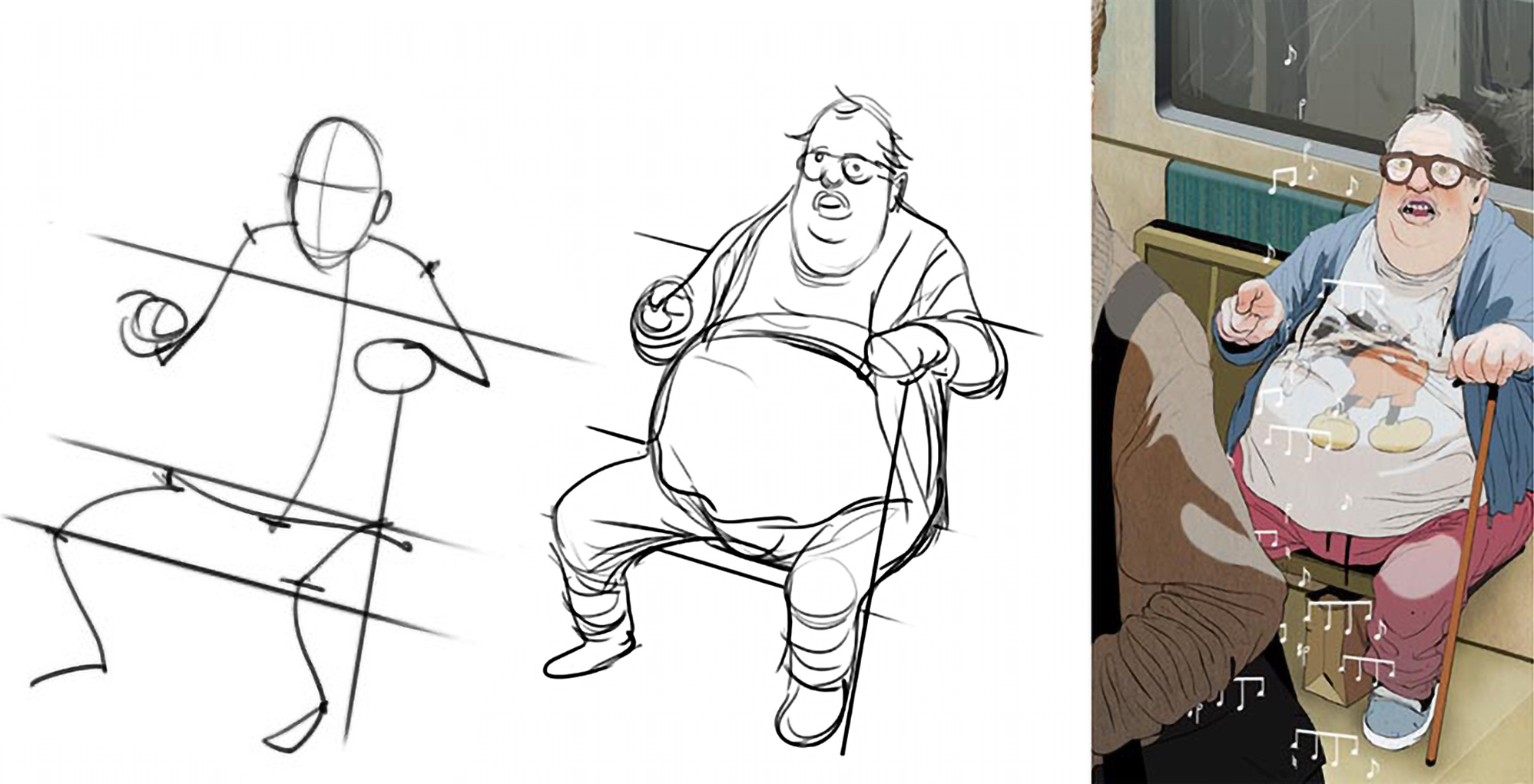
In addition to the initial sketch of a drawing where you get the general idea of the pose down, getting the details right is also important. As I mentioned before, any line you put down that doesn’t strengthen the basic story of the drawing you’re making serves to weaken it.
This is just another way of saying that to draw is to design.
In drawing just as in storytelling, you’re usually going to want to communicate as clearly as possible. Silhouettes offer the fastest, clearest communication of gesture. Will Eisner explained silhouettes in his book “Graphic Storytelling and Visual Narrative,” which I highly recommend.
Foreshortening
Obviously it is often more difficult to show the gesture on a foreshortened figure than on one shown at a more conservative angle, because a strong grasp of three-dimensional form and basic anatomy come immediately into play in such cases.
Consider your pose in such instances; it may be possible to tilt the angle of the viewer so that there is a clearer story expressed in the silhouette.
The biggest challenge with designing foreshortened figures (after the actual foreshortening part) is keeping the silhouette from being a “bean” and losing all the dynamism of the pose.
Also, you can use a digital camera and a self-timer, or a friend to quickly check and adjust accordingly the way you’ve designed the pose and make necessary adjustments.
It’s essential to use reference while drawing. Failing to use a camera, mirror, or something else when you need it is like not using a dictionary to first look up a word you don’t know the meaning of that you want to use in an essay.
Designing for the Page
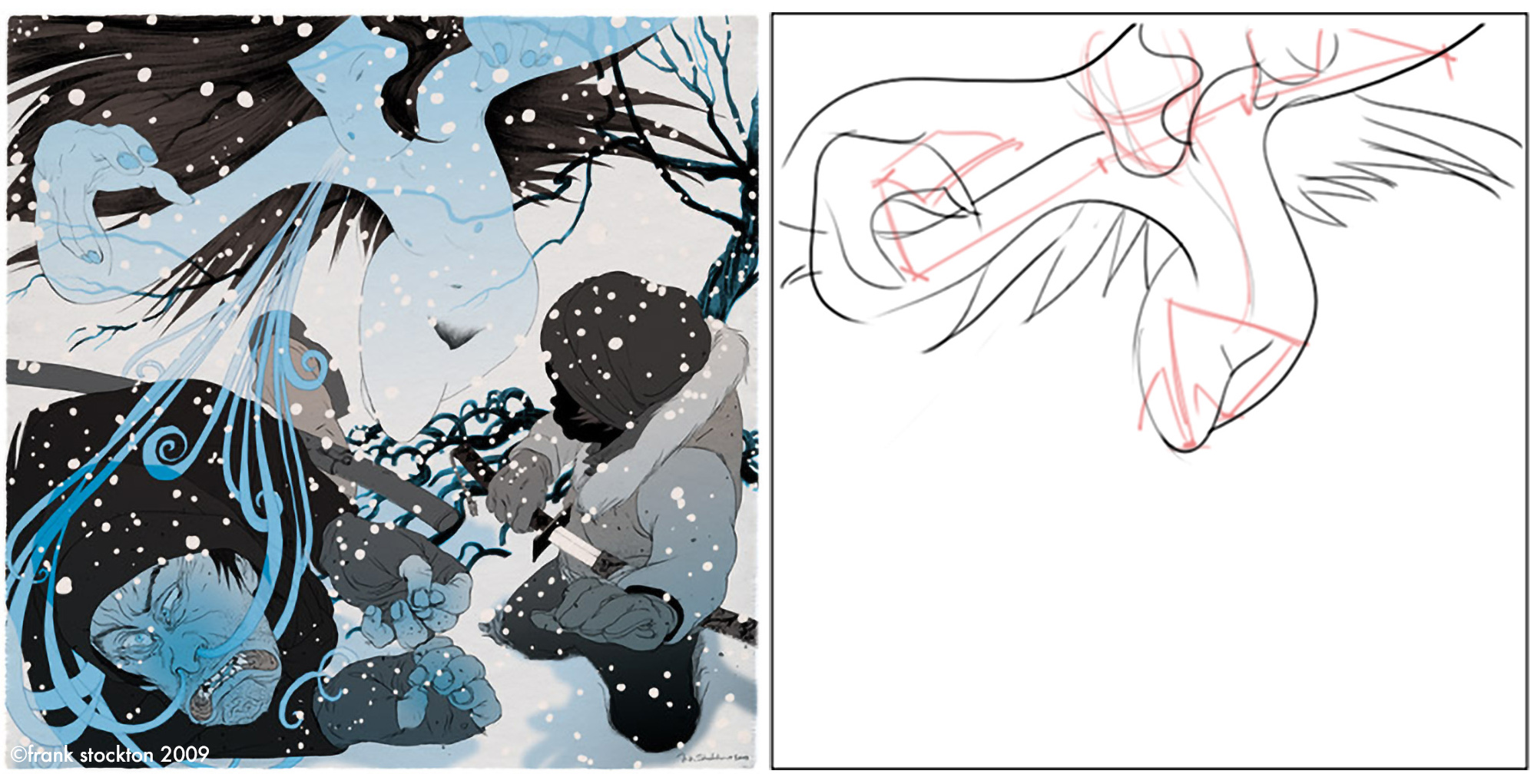
The light red lines on this drawing represent a more realistic proportion and structure for the Yuki-Onna, while the black lines represent the gestural lines that she was actually based on.
A key difference between the way an illustrator draws and an animator or cartoonist draws is in designing for the page.
Often times in illustration there isn’t as strong of a need to stay “on model” as there usually is in comics, cartooning and animation.
Letting go of the principles you’ve practiced over and over in the drawing workshops to make more interesting illustration can be both extremely daunting and exciting at the same time.
The key to making this work is realizing that there are no limits to what the figure can do when you put it down on paper; as long as you are able to communicate the idea, the possibilities are as endless and free as you permit yourself to imagine.
Always push your design. It’s much easier to take a step back from going too far than it is to push forward when you haven’t gone far enough.
If you’ve noticed, this is just “design” in a broader sense, not just figure invention.
The ultimate truth of drawing figures or anything else is that it comes down to your skills as a designer; if it looks good, it’s because you designed it well, and if it looks bad, it’s because you didn’t design it well; it has nothing to do with how much anatomy you know or how well you understand the principles of drawing.
All that knowledge is helpful for informing your design choices, but it doesn’t guarantee you a good drawing.
Practicing
It’s important that no matter what teacher you are learning from that you practice drawing out of your imagination on your own, AS WELL AS from life.
You MUST set aside time on a regular basis if you want to improve. It’s more beneficial to spend 30 minutes studying the figure on a daily basis than it is to spend four hours in a workshop once a week.
Life drawing should be thought of essentially as “the lab” where you test out ideas and try to figure out what works for you.
Drawing from life is a key component of the over-all equation of learning to draw, as is drawing from your imagination and studying the drawings of other artists.
Do whatever you have to do to make practicing interesting and fun for yourself. If the idea of practicing the figure sounds boring to you, your brain will essentially shut off and you’ll just be wasting your time. Find a way to make it fun.
Do not strive to copy exactly the way any one teacher explains to you to draw. It MUST be a process of trial and error. You are essentially trying to find out your own way to do things. This is how you will engage your brain so that you learn quickly.
Practice on your own. Your deficiencies in figure invention will become immediately apparent. Make note of your weaknesses and attack them when you draw from life. You are working to develop your own understanding of the figure.
One way to practice figure invention is to draw comics, which can give you scenarios you never thought of to illustrate.
Listen to different teachers and find out where their ideas overlap. Strive to find the principles and the core messages they are delivering; don’t get wrapped up in their process.
Any teacher is explaining to you their own unique understanding. You cannot understand things exactly the same way they do, so you must strive to find your understanding. You must walk your own path parallel to your heroes, but not try to follow in their footsteps.



22 Comments
Add Yours →I found your blog by the best way…. You posted a thoughtful, honest and inspired assessment of another artist. It was so good i had to look up your stuff and i was so happy i did. Your blog is a trove of great information for a student of illustration like myself. This latest post is so timely for me it's spooky… I often draw from my own mind far too much. This post by focusing on the benefit also accurately stressed the limitations of drawing from the mind. I look forward to part two and kicking my own but into gear this summer and drawing the figure more.
thank you for taking the time to post this.
Thanks matey, this kind of stuff is very helpfull =)
Hi Frank, I stumbled across your page/blog a few months ago and subseuently became a regular re-visitor and reader. Thanks for such an insightful post and while the principles are constantly reflected in many drawing and reference guides, it's really refreshing to see them put alongside your art. I've nothing but even more respect for your work now, and have rekindled a strong desire to practice, practice practice. Thank you!
Great post! I really enjoyed reading through all of this.
Your analogy of not using a mirror or camera while composing a visual story being like not using a dictionary for uncertain words while writing is perfect.
Excellent post! I can not to wait for the next installment!
Thanks for taking the time to post this Frank. Very informative, i'm gonna go out and try this out today and post results on my blog.
thanks a lot for this post, Mr Stockton!
I posted about this but I guess it didn't take. Oh well.
At any rate, Thanks so much for this.
amazing! i can't wait to pour over this some more. i love your blog, its such a source of inspiration and insight. thank you very much for everything.
– an illustration student
Thanks Frank. Great article. Well written and concise. Great stuff to keep in mind at any stage of art life.
Well put , and sage advice for any illustrator at all stages of their development.
BTW – did you score the cover of the Communication Arts Illustration annual ? If so , a big congrats.
I was fortunate to have a few pieces myself included in this years annual. Can't wait to see it.
Thank you for sharing your advice. I felt my mind open a little while reading this and hope that it will benefit my work eventually.
Can you clarify this passage:
"The ultimate truth of drawing figures or anything else is that it comes down to your skills as a designer; if it looks good, it's because you designed it well, and if it looks bad, it's because you didn't design it well; it has nothing to do with how much anatomy you know or how well you understand the principles of drawing."
When you speak of design in this instance, does it mean the overall composition? Or that and a combination of how the elements tell the story? Because I have realized that if the composition is poor, nothing can really save it. And if the storytelling is not convincing, it will not be interesting.
Thanks for the comments, guys.
M, to answer your question about the statement
"The ultimate truth of drawing figures or anything else is that it comes down to your skills as a designer; if it looks good, it's because you designed it well, and if it looks bad, it's because you didn't design it well; it has nothing to do with how much anatomy you know or how well you understand the principles of drawing."
What I mean is that any line or set of lines you put down are immediately a design. You need to understand the drawing at a graphic level to make better drawings. To illustrate, it's why the drawings of Henry Darger, Matisse, Schiele, and Rubens are all great; because they are appealing to look at (and, thus, well-designed). It can hardly be argued that some of them are more well-trained and classical in their knowledge than the others, but the fact that all of them are well-loved for their drawings is due to the fact that they are able to make images that are appealing to look at.
I hope that clarifies the statement for you, it's not an easy one to verbalize.
–frank
this is fantastic advice, heard parts before, but in a manner that it bears repeating. fresh voice for tired ears.
thank you
excellent post frank.
Thank you for this post. Waiting for the next one 🙂 .
The timing of this post into my life is uncanny.
I'm a student of graphic design, but my first love has always been illustration. Recently, I decided that although my school does not have an illustration degree nor can I afford to transfer to a school that does, that I would forge ahead to specialize in illustration anyways.
I've begun drawing in a more deliberate way, rather than the general sketching I usually do. As you pointed out will happen, my short-comings have become blindingly obvious. I was becoming a little disappointed in myself– how could I think I could work in this profession if I can't even render certain basic elements properly? You brought to mind something a teacher told me once: if you're struggling with a concept over-much, you need to take a step back; you're doing something wrong. He was talking about advanced chemistry, but the idea applies. Go back to the basics, and approach it from a new direction. Find a way that works for you, regardless if the way you were doing things worked for someone else.
So thank you for this post. I wish I had come across your blog earlier; this year's Con was a giant confirmation of "this will be hard, but it is so worth it". In any case, I look forward to hearing more of what you have too say.
great post. people can really learn from you. keep them coming.
Many Thanks to you!
This post is a great help not just for art students but for everyone who's willing to draw and to improve their skills.
Thanks you, this post helps me a lot 🙂
Rarely have I seen a post about art that contains so much truth. I struggled with not tweeting every quote.
thank you so much for posting this!! i have so many ideas i just cant seem to draw them out and this will definitely help 🙂